Looking for a backtest at 84 with stops below the breakout point. Target should be near $100.
Wednesday, April 7, 2010
Oil 4/10
Looking for a backtest at 84 with stops below the breakout point. Target should be near $100.
10 Yr Notes
Thursday, February 25, 2010
SFR
A new record low for new home sales. One has to ask what is going to cause new home sales to increase. Sure inventories have dropped significantly, but what is going to cause a new home buying spree? Unemployment is menacing. The foreclosure, shadow inventory numbers are not good. Interest rates can't go markedly lower. So, where does that leave land prices. Here's a look at Seattle land values using the Land Residual Value Calculation. In the good 'ol days it worked something like this:
Home Price 300,000 100%
Construction costs 105,000 35%
Carry costs 30,000 10%
Selling Costs 30,000 10%
Land Improvements 45,000 15%
Gross Profit 45,000 15%
Raw Ground Value 45,000 15%
Case Shiller shows a 22% peak to current price decrease dropping the idealistic price example above to $234,000. The first to absorb this blow was the builder's gross profit expectation. The balance has been taken out on the Raw Ground Value dropping it to $30,600. A nasty 32% drop, jeopardizing the lenders original LTV of 70% to 75%. Another 10% to 15% dropped in home values will wipe out the value of the land on the builder's books. What's a builder to do? Another builder won't buy the land unless the profit is put back into the deal. Per the above calculation adding in a 15% gross profit takes another $35,000 from the land value taking it negative. So even without a further decline in home prices, raw ground is already underwater. The clever buyer would be looking to Bank REOs and be prepared to negotiate prices down with Subs, Suppliers & Agents.
Do you think it's not happening? Check out this article:
http://www.theolympian.com/2010/02/14/1137264/missing-headline-for-14obuildings.html
Here's the money quote:
“There are so many lots being flooded on the market right now that you can buy lots at or less than the cost of production,” he said. “Land values have essentially gone to zero.”
Sunday, February 21, 2010
Monday, February 15, 2010
A Tale of Two Towers - update
Let take a closer look at a hypothetical building in 2007. The major factors affecting the value of this building: rental rates, vacancies and capitalization rates were average for the market. Based on it's operating income of $70,000 it was valued at $1,000,000 as shown below:
Rental rate 100% of the market rate
Vacancy rate 7%
Operating Income $70,000
Cap Rate 7%
Cap Value $1,000,000
Since 2007, all factors affecting value have weakened.
Rents are down over 20% (and going lower).
Vacancies are up nearly 13% (and going higher). Capitalization rates are probably 300 bps higher (and as the meltdown continues, headed higher). Today our hypothetical building has probably lost over 50% of its value:
Rental rates 80%
Vacancy rate 20%
Operating Income $44,800
Cap rate 10%
Cap value $448,000
Ouch! A 50% haircut. So, how do you beat the math in this trilema? Find an owner/occupant participant who can take on 50% of the available space, and, a building facing a 50% vacancy rate. Show a potential owner/occupant rental rates 20% lower than 2007 with an equity kicker and you probably have a partner.
A Tale of Two Towers


How was Northwestern Mutual able to get twice as much space for $53,000,000 less? Easy. WaMu Center's first sizeable tenant will be Northwestern owned Russell Investments. Prior tenants (Washington Mutual) were blown out by the finance crisis. On the other hand, Expedia leases 85% of Expedia Tower and is currently near full occupancy.
Note to Landlords: Don't lose tenants.
Note to Investors: Team up with a potential owner/occupant. If you can fill up half the space, the rest is almost free.
Monday, November 2, 2009
Banks putting the squeeze on Developers
Banks foreclosing on Whatcom County's unsold condo projects
http://www.thenewstribune.com/news/northwest/story/927549.html
Chapter 11 for Cascadia
http://www.thenewstribune.com/topstories/story/919317.html
Seattle developer Mastro has huge debts, bankruptcy papers show
http://seattletimes.nwsource.com/html/localnews/2009843640_mastro11.html?prmid=obnetwork
Frontier Bank sues Edmonds developer over $40 million in unpaid loans
http://www.heraldnet.com/article/20091016/BIZ/710169861
The following Banks were mentioned in the articles:
Horizon Bank
Bank of the Pacific
Whidbey Island Bank
Seattle Bank
Columbia State Bank
First Sound Bank
Venture Bank
HomeStreet Bank
Frontier Bank
Guess what many of these banks have in common?
Check the Troubled Bank List at Calculated Risk.
http://www.calculatedriskblog.com/2009/10/unofficial-problem-bank-list-grows-to.html
Regulators are putting the screws to many of the Banks pressing foreclosure.
Horizon Bank _______3/3/09 _____Cease & Desist
Bank of the Pacific
Whidbey Island Bank
Seattle Bank ________6/08/09 ____Cease & Desist
Columbia State Bank
First Sound Bank
Venture Bank _______9/11/09 _____Failed
HomeStreet Bank ____5/08/09 _____Cease & Desist
Frontier Bank _______3/20/09 ____Cease & Desist
I imagine they would also fit the classic definition of “motivated sellers.”
Saturday, October 31, 2009
CRE Prices
The 18 month lag between Residential & Commercial properties appear in tack this cycle. “If” the residential prices are near the bottom, then commercial ought to bottom next fall. Where might prices be then?Rents
Locally, office rents dropped sharply during the 3rd quarter. Cushman & Wakefield recently stated: “In downtown Bellevue, leases slid from $38.11 per square foot per year in the second quarter to $35.25. In downtown Seattle, they dropped from $33.23 to $31.90.” (http://seattletimes.nwsource.com/html/businesstechnology/2010001514_office05.html ). That’s 16% annualized in Bellevue, and, over 30% in Seattle. A continued drop in rents is baked in the cake. For example, Northwest Mutual’s purchase of the WAMU tower gives them a lot of space to rent, and a significant cost advantage. Undoubtedly they will offer lower rents that meet their target returns, but kill the whole market driving rents down.
A large nationwide CRE holder, Liberty Property Trust reported that: “For the third quarter rents decreased by 13.9%. We expect this third quarter experience to repeat itself for the balance of 2009 and for 2010. We are projecting that rents for 2010 will decrease by 10 to 15% on a straightline basis.” That would put rent decreases near 25% from their peak.
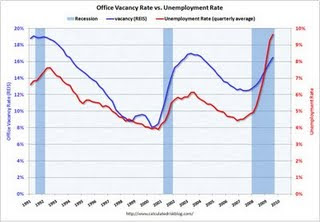
Nationwide Office vacancy rates are over 16%, after bottoming at 8%. Office vacancies appear to lag unemployment pretty closely. A top in unemployment will be a good confirmation of a coming low in office vacancies. The sharp increase in unemployment ensures that current leaseholders have ample room to house new employees prior to needing additional space, diminishing demand for office space.Puget Sound vacancies are tracking the nationwide market.


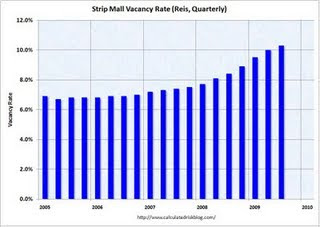
Strip mall vacancies have no where to go but up. Take a quick drive thru your favorite strip mall and decide if 10% vacant is adequate.
Cap Rates

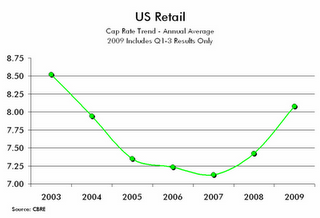
Liberty Property Trust disclosed recent cap rates on actual sold office properties: “The cap rate on these sales will be in the 9 to 11% range.” These sales were negotiated early in the year. Do you think your local lender would be willing to lend based on a 10% cap rate, given their own problems? Not a chance, unless you have pile of money to put down at closing.
So where should CRE prices end up next year? Rents dropped precipitously during the 3rd quarter. Drops from peak pricing will be 20%. Vacancies haven’t seen a bottom yet, but so far have increased from about 7% to 16% in the Puget Sound. 20% vacancies will hit early next year. Capitalization rates have increased from 7% to at least 10%. Where does that leave prices?
Rental Rate 100% 80%
Vacancy Rate 7% 20%
Capitalization Rate 7% 10%
Operating Income $70,000 $47,600
Capitalized Value $1,000,000 $476,000
Ouch! A 50% haircut from the peak, even with generous assumptions. It is unlikely a stretched investor would be willing to accept a 50% haircut, since the LTV on the project was closer to 65%. How can they repay the loan? Rather, a short list of banks would probably be ecstatic to take the haircut on their loan, get some cash and help get the regulators off their backs.

The Case Shiller has shown a pretty feeble pickup in prices during 2009, especially considering the total lack of interest in new homes as shown by the number of new homes sold in December.